
Samaritan Road If you need help today

Neighbors helping neighbors, through the local church.

Samaritan Road is being built to help a church run its outreach and events. The church chooses what it is equipped to offer, reviews every need, and sends its people to serve: in the church, in the region, and in the world.

In development. Not yet open to churches or the public.

“Go and do likewise.”

Jesus, in Luke 10:37
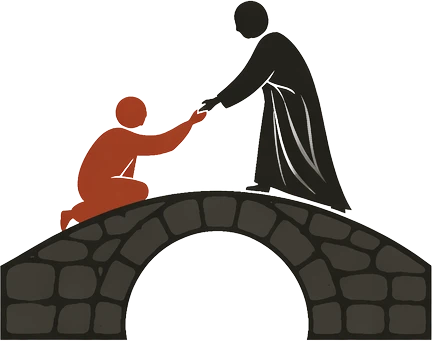
The Samaritan Road mark: two figures on a stone bridge. One kneels, and the other reaches down to take their hand.

Named for a story Jesus told

An expert in the law asked Jesus who his neighbor was. Jesus answered with a story about a man robbed, beaten, and left half dead on the road from Jerusalem down to Jericho. A priest passed by on the other side. So did a Levite.

An aerial photograph of a narrow road winding down through bare, folded desert hills beside a deep gorge.
The road down to Jericho, seen from the air in 1931. It falls about 3,300 feet in 15 to 18 miles. Matson Photograph Collection, Library of Congress.
33

But a Samaritan, as he traveled, came where the man was; and when he saw him, he took pity on him. 34He went to him and bandaged his wounds, pouring on oil and wine. Then he put the man on his own donkey, brought him to an inn and took care of him. 35The next day he took out two denarii and gave them to the innkeeper. ‘Look after him,’ he said, ‘and when I return, I will reimburse you for any extra expense you may have.’

36“Which of these three do you think was a neighbor to the man who fell into the hands of robbers?”

37The expert in the law replied, “The one who had mercy on him.”

Jesus told him, “Go and do likewise.”

Luke 10:33-37 (NIV)

How a church runs its outreach

  1. The church chooses its outreach

    Each church offers only what it is equipped to run. That might be a food pantry on Saturdays, homeless outreach, prayer and care, a week of service across its region, storm response, or mission trips, along with events like a family movie night or a men’s conference. Nothing is asked of a church that it has not chosen.

  2. Every need is reviewed

    A request for care, for yourself or for someone else, goes to the church’s care team, never to a public board. Coordinators review every need and approve every volunteer before anyone serves. Samaritan Road is not a place to request services, and it is built to stay that way.

  3. Volunteers serve

    Approved volunteers sign up for the shifts and events their church has scheduled: in the church, in the region, and in the world. Teams share what they saw as testimonies, the church sees the totals, and the people they served are never named or pictured.

Outreach we offer

In the church

  • Prayer and care
  • Community nights
  • Clothing closet not yet

In the region

  • Food pantry Saturdays
  • Homeless outreach
  • A week of service
  • Storm response when needed

In the world

  • Mission trips
  • Praying for partners abroad
An example of one church’s choices. Every church’s list is its own, and it can change at any time.

Three parts, built in order

Organization Portal

For coordinators. Being built now.

Coordinators approve and organize volunteers, review local and global needs, organize events and outreach, and see the result of the care they give, in an interface that is easy to tailor to their church. It is the backbone of Samaritan Road.

An example of the portal’s Today page, with fictional names. What is waiting on the coordinator sits on the road; answer it and the road is clear.

Volunteer App

For volunteers. Next.

Volunteers see the shifts and events their church has scheduled and sign up to serve. They can see their personal and overall impact, and communicate with team leaders and organizers quickly and efficiently.

Community App

Later, after the portal and the Volunteer App.

Ask for care simply and easily, for yourself or for someone else, through the programs your church offers. Once your request is reviewed for safety, your church connects you with care from trustworthy volunteers.

It will only ever open the programs a church chooses to open, and every request is reviewed by that church.

What we hold to

Dignity first.
People who receive care are never put on display. Stories are told by the people who served, and no one is ranked or compared.
Trust through the local church.
Trust comes from a congregation that knows its people, not from stars and reviews.
Safety without exceptions.
Volunteers are checked to the level each kind of service needs, and anything involving children follows a two-adult rule.
Close-knit by design.
Care happens only through outreach a church has chosen and reviews. It is not a marketplace, and not for work a person would hire a professional to do.
Simple enough for anyone.
Someone who runs the church food pantry should be able to pick it up on a Sunday afternoon, with no training.
Mission over metrics.
We measure care given, not time spent in an app. No ads, no selling data, and no tricks to keep anyone scrolling.

If you need help today

Samaritan Road is not taking requests for help. If you need help now, please contact a church near you. Many churches care for neighbors whether or not they attend.

Where things stand

October 2026

Samaritan Road is in development and not yet open to churches or the public. We are preparing a first pilot and building carefully, one church at a time.

It is being built to be free for every church and every person who uses it. There is nothing to buy, and nothing to sign up for yet.